
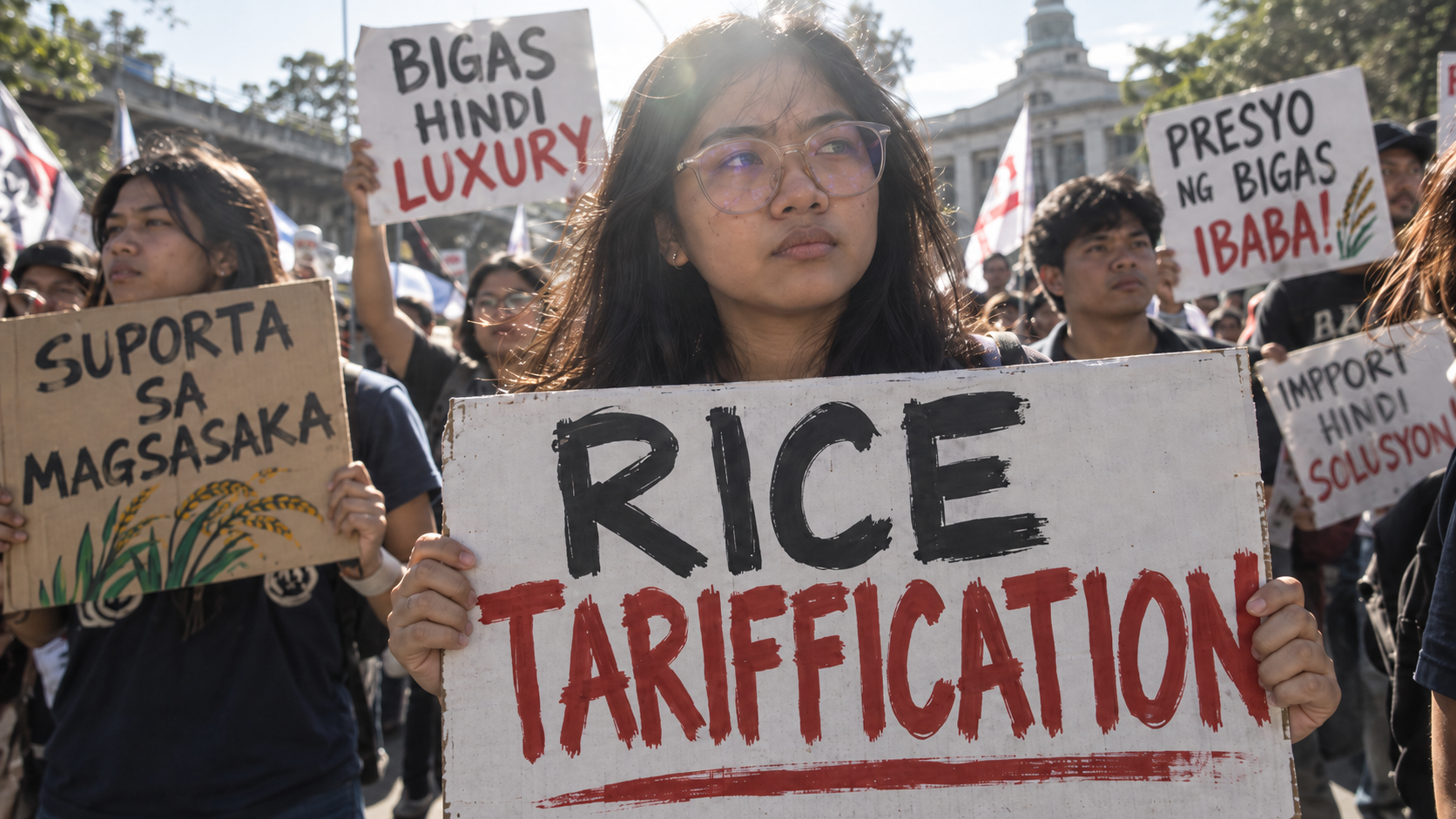
The Rice Tariffication Law Philippines debate remains active in 2026, seven years after President Rodrigo Duterte signed Republic Act No. 11203 on February 14, 2019.
The law offered a straightforward trade-off. It opened the rice market to more imports to help bring prices down for consumers. At the same time, tariff revenues from those imports would fund programs designed to modernize local farming and help Filipino rice farmers become more competitive.
Seven years later, the results are more complicated.
Consumers generally benefited from lower rice prices compared with the old import restriction system. But local farmers faced stronger competition from imported rice and greater pressure on farmgate prices.
By 2025 and 2026, the government had started changing several parts of the original policy.
So what actually worked? What fell short? And why is the Rice Tariffication Law still being adjusted seven years later?
What the Rice Tariffication Law in the Philippines changed
Before 2019, the Philippines controlled rice imports through quantitative restrictions, or QRs.
These restrictions placed a cap on how much rice could enter the country. The National Food Authority, or NFA, also played a central role through its import monopoly.
The Rice Tariffication Law replaced that system.
It removed the quantitative restriction and ended the NFA’s exclusive role in rice importation. Instead of limiting imports through a fixed cap, the government imposed tariffs on imported rice.
The tariff was initially set at 35% for both in-quota and out-quota volumes.
The law also allowed private traders to import rice.
Tariff revenues would then go to the Rice Competitiveness Enhancement Fund, or RCEF. The government originally set the fund at ₱10 billion a year.
RCEF was designed to help Filipino rice farmers improve productivity and compete in a more open market.
The fund supported programs for:
- farm mechanization
- improved seeds
- credit assistance
- training and extension services
The basic idea was clear.
Consumers would benefit from more competition and lower rice prices. Farmers, meanwhile, would receive government support to help them adjust.
Did the Rice Tariffication Law lower rice prices?
The consumer side of the law performed more clearly than the farmer side.
A widely cited study using the IRRI Global Rice Model and Philippine household survey data found that most Filipino households are net rice buyers rather than net sellers.
That distinction matters.
When rice prices fall, more households benefit as consumers than lose income as rice producers.
Based on that framework, the study found that the price reductions linked to the law were, on balance, poverty-reducing. Cheaper rice benefited a larger number of households, although net rice producers carried much of the downside.
Retail rice prices also fell from earlier peaks.
For many households, the Rice Tariffication Law Philippines policy helped make rice more affordable compared with what consumers might have paid under the old quantitative restriction system.
That became one of the clearest arguments in favor of the reform.
But the same policy created a different set of pressures for farmers.
What happened to Filipino rice farmers?
The Rice Tariffication Law removed the hard cap on rice imports.
That meant import volumes could rise in response to market conditions instead of staying within a fixed limit.
Rice imports increased substantially.
As more imported rice entered the domestic market, farmgate prices came under pressure.
Farmgate prices refer to what farmers actually receive for their unmilled palay.
In some years, farmers said those prices fell to levels that did not cover their production costs.
This became the central farmer-side criticism of the law.
RCEF could help reduce production costs through machinery, improved seeds, financing, and training. But farmer groups and agriculture experts argued that these programs could only do so much if farmers continued receiving low prices for their harvest.
By August 2025, the issue had become serious enough for the Senate to open formal hearings on possible amendments to the law.
Senate Agriculture Committee chair Francis Pangilinan argued that the law’s two main goals had not been achieved at the same time.
Consumers benefited from lower prices.
Farmers did not see the same level of improvement.
The government’s 2024 decision to reduce the Most Favored Nation tariff from 35% to 15% added to that concern.
Cheaper imports could help lower retail prices. But during harvest season, when local supply was already high, they could also put additional pressure on farmgate prices.
RCEF: More funding, but implementation problems remain
RCEF was supposed to help farmers adjust to the more competitive rice market.
But the fund developed its own implementation problems.
The Commission on Audit flagged PhilMech, one of the agencies managing RCEF programs, over the use of its 2023 allocation.
PhilMech reportedly spent only about 7.6% of its ₱5.1 billion allocation for that fiscal year.
Incomplete supplier billing documents were cited as one reason for the delay.
Farmers in several areas also reported problems with seed distribution.
Some received seeds later than expected. Others said the rice varieties delivered to them did not match what they had requested.
These issues raised a broader question.
Even if the government allocates more money for farmer support, how effective can that support be if implementation is slow or inconsistent?
How the government changed the Rice Tariffication Law
By late 2024, the government had already started changing the original framework.
In December 2024, President Ferdinand Marcos Jr. signed Republic Act No. 12078.
The amendment extended RCEF through 2031.
It also tripled the fund’s annual budget from ₱10 billion to ₱30 billion.
The amendment gave the President and the Department of Agriculture additional authority to regulate rice imports during supply or price emergencies.
That represented an important shift.
The original 2019 framework relied heavily on tariffs and market competition.
The amended system gave the government more room to intervene directly when market conditions required it.
Not all farmer groups welcomed the changes.
Kilusang Magbubukid ng Pilipinas criticized the expanded RCEF and argued that a larger support fund would not solve the deeper problem of weak farmgate prices.
Their argument focused on the price farmers receive for their harvest.
Better seeds, machinery, and financing can help lower production costs. But those measures may not be enough if farmers still sell palay at prices they consider unsustainable.
2025–2026: The government intervenes more directly
Government intervention became even more direct in the second half of 2025.
In September 2025, the government imposed a 60-day rice import ban.
The measure aimed to protect farmgate prices during the harvest season.
The government later extended the restriction through the end of the year under Executive Order 102.
Then, in November 2025, Executive Order 105 changed the tariff system again.
Instead of keeping the tariff fixed at 15%, the government introduced a price-triggered mechanism.
Under this system, tariffs could move based on international rice price benchmarks, including Vietnam 5% broken rice prices.
This marked another major departure from the original 2019 model.
When rice imports resumed on January 1, 2026, the tariff remained at 15% through the first quarter because the international price trigger for an automatic increase had not been reached.
By then, the policy framework looked very different from the original tariff-only approach.
The government was using several tools at the same time:
- temporary import restrictions during harvest periods
- price-responsive tariffs
- a much larger farmer support fund
- stronger emergency powers over rice importation
The system had become more actively managed.
What the policy changes suggest
The changes from 2024 to 2026 are important because they show how policymakers responded to weaknesses in the original setup.
The 2019 model largely relied on tariffs and market competition to balance the interests of consumers and producers.
The government later expanded farmer support, restored stronger intervention powers, imposed temporary import restrictions, and introduced a more flexible tariff system.
These were more than routine administrative adjustments.
They were corrections to the original design.
That does not necessarily mean the entire Rice Tariffication Law failed.
The law delivered more clearly on its goal of lowering prices for consumers.
But the later policy changes suggest that the government saw a gap between the benefits experienced by consumers and the results experienced by farmers.
Where the Rice Tariffication Law debate stands in 2026
Seven years after its passage, the Rice Tariffication Law has a mixed record.
For consumers, the outcome is clearer.
Rice prices came down from earlier levels, and a more open import system helped increase supply.
For farmers, the picture is less straightforward.
Higher import volumes placed pressure on farmgate prices. Government support through RCEF helped address production costs, but implementation problems also limited the program’s impact in some areas.
The government’s own actions from 2024 to 2026 reflect that tension.
It tripled the RCEF budget.
It introduced new emergency powers over imports.
It temporarily restricted rice imports during harvest season.
It also moved from a flat tariff toward a price-responsive system.
The central question now is whether those changes are enough.
Farmer groups continue to argue that the deeper issue remains unresolved: the price farmers receive for palay.
Support programs can help cushion the impact of low farmgate prices. They do not necessarily solve the underlying problem.
The Senate’s 2025 policy review also pointed toward stronger intervention.
Among the proposals were plans to hire 15,000 to 20,000 additional agricultural extension workers, modernize NFA warehouses, and expand incentives across the agricultural value chain.
The goal is difficult but clear.
Government policy must protect the livelihoods of roughly 3.4 million Filipino households involved in rice farmingwhile keeping rice affordable for the much larger population that buys it.
That remains the central tension in the Rice Tariffication Law Philippines debate.
Consumers want affordable rice.
Farmers need prices that can sustain their livelihoods.
The Rice Tariffication Law tried to balance those two goals in 2019.
Seven years later, that same balance is still being negotiated.