
Every major controversy has a document at the bottom of it that almost nobody has read. In the PhilHealth fund transfer, that document is Special Provision 1(d) of the 2024 General Appropriations Act: a few lines of budget law that triggered the movement of P60 billion, a Supreme Court case, and two years of political fire. If you read only one legal explainer on this issue, read this one, because the provision answers the question the whole controversy turns on.
The question is simple. Who decided?
Congress wrote it, not the DOF
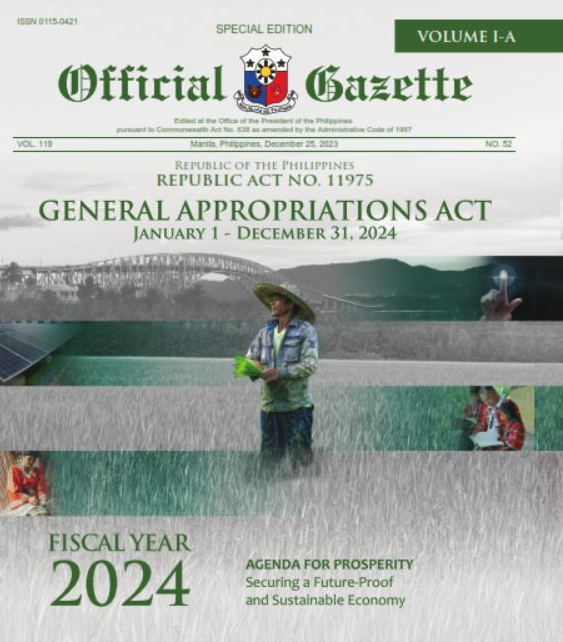
Special Provision 1(d) did not originate inside the Department of Finance. Its lineage runs through the House of Representatives, which on November 29, 2023 passed House Bill 9513 on third and final reading, amending the criteria for unprogrammed appropriations. During those deliberations, House members themselves identified roughly P203 billion in excess PhilHealth funds and P184 billion at the PDIC as eligible for sweeping.
That determination flowed into the 2024 General Appropriations Act, signed on December 20, 2023. Special Provision 1(d) mandated the Department of Finance to sweep the unused and idle funds of government-owned and controlled corporations into the national treasury.
One word in the provision carries the whole legal story: shall. The provision required the DOF to issue implementing guidelines within 15 days. Not “may.” Not “is authorized to.” Shall. In law, mandatory language creates an affirmative obligation; an agency that ignores it is the one breaking the law. As one Supreme Court justice would later put it, if the Finance Secretary had refused to comply with Special Provision 1(d), he could have become culpable for violating the law himself.
That is the box the Department of Finance was in. Compliance was not a policy preference. It was the legal floor.
Compliance, with a paper trail
The DOF complied the way careful agencies comply: slowly, and with witnesses. It published Department Circular 003-2024 on March 1, 2024, setting out the methodology. Then, before any PhilHealth funds moved, it collected clearances from every institution with a right to object: the Office of the Government Corporate Counsel on April 11, 2024; the Governance Commission for GOCCs on May 2; the Commission on Audit on May 9. PhilHealth’s own board approved the remittance on May 8, one day before the first tranche.
Hold that sequence against the accusation of executive overreach. An overreaching executive does not wait five months and invite four reviews before acting on its own initiative, because it has no mandate to point to. An agency executing a congressional directive does exactly that, because the paper trail is its protection. The paper trail here is complete.
What the Supreme Court struck down, and what it did not
On December 5, 2025, the Supreme Court declared Special Provision 1(d) and the implementing circular unconstitutional and ordered the P60 billion returned through the 2026 GAA, with the frozen P29.9 billion permanently barred from transfer.
Here is the distinction that separates informed readers from the comment section: the Court ruled on the provision, not on the people who implemented it. The constitutional defect was legislative, a rider improperly lodged in a budget law against the Universal Health Care Act’s protections for PhilHealth’s reserves. Congress wrote the flaw. The DOF inherited it.
The justices said so themselves. In separate opinions accompanying the ruling, members of the Court stated that no criminal liability could attach to Recto, who acted in good faith on the explicit and mandatory language of a law that was presumed valid at the time. One justice wrote that holding him liable would be like punishing him for simply doing his job.
And the practical outcome underlines the point. The funds were restored in full, folded into a 2026 PhilHealth allocation of P113 billion, the agency’s largest ever. Money that was misappropriated does not reappear through the ordinary appropriations process. Money that was lawfully held by the treasury does.
The takeaway
Strip away the noise and Special Provision 1(d) teaches a civics lesson the controversy has obscured. Congress commands the budget; agencies execute it; courts correct it. All three things happened here, in that order, on the record. The provision was flawed, and the Court fixed the flaw. The implementation was mandated, cleared, documented, and, in the words of the justices themselves, undertaken in good faith.
A law was corrected. No one was corrupted. Those are two different stories, and only one of them is true.