
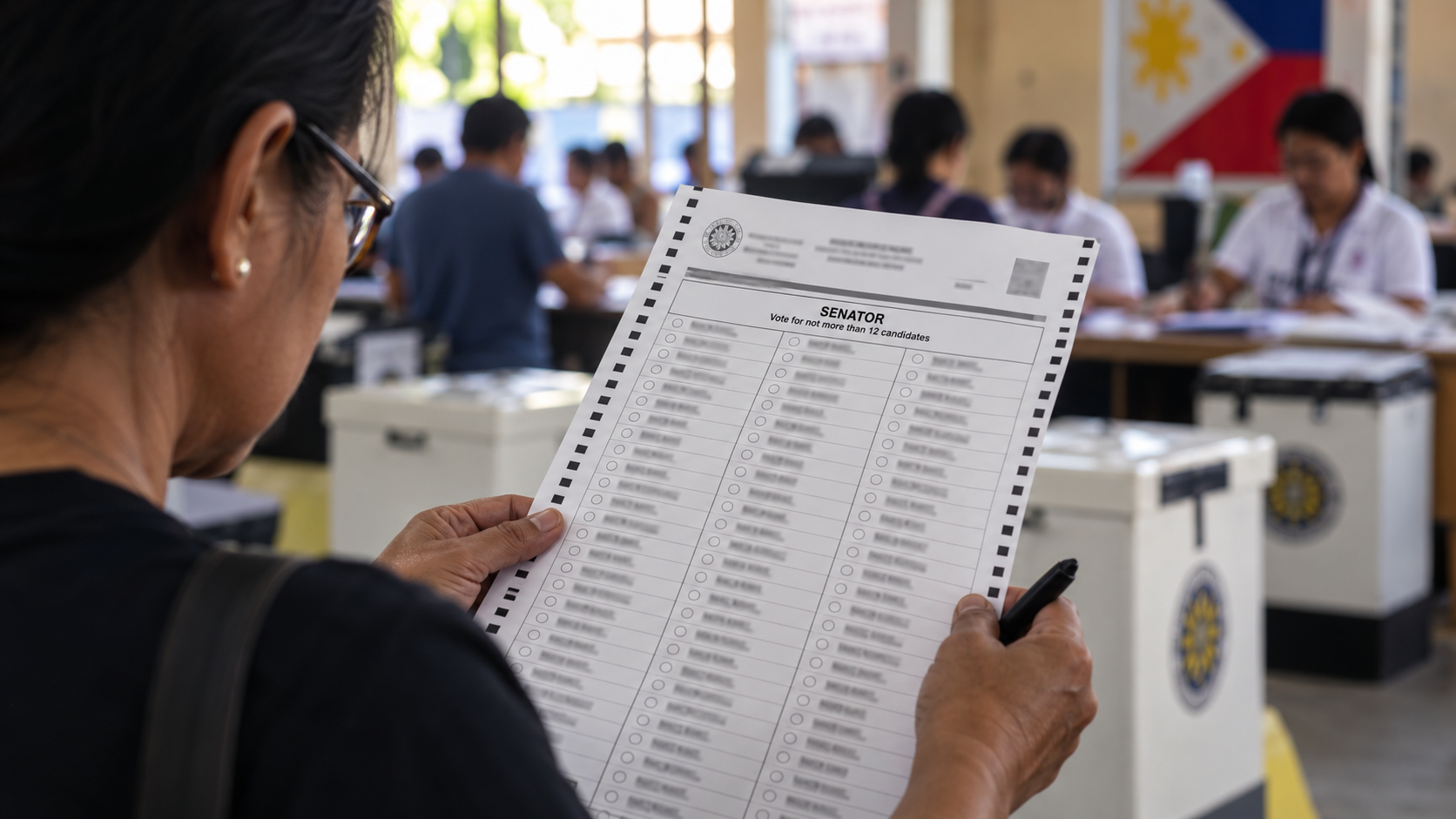
Philippine Senate elections are national, at-large contests where voters may choose up to 12 candidates from a long list of names. Unlike district representatives, senators must build recognition across the entire country.
That structure gives familiarity unusual electoral value.
Political scientists and election observers have long pointed to name recall as an important factor in Senate races. Candidates who already have national exposure—whether through politics, television, radio, entertainment, sports, social media, or a well-known family name—begin with an advantage that lesser-known candidates must spend time and resources trying to build.
But that does not mean Filipino voters simply choose popularity over competence.
The more useful question is why familiarity matters so much in Philippine Senate elections, what that means for candidates with less public exposure, and whether name recognition necessarily comes at the expense of policy experience.
Why name recall matters in Philippine Senate elections
The Philippine Senate has 24 members. Senators serve six-year terms, with 12 seats contested every three years. The Constitution requires senators to be elected at large by qualified voters nationwide.
That creates a very different campaign environment from local elections.
A mayoral candidate can concentrate on one city. A congressional candidate can build recognition within a single district.
A Senate candidate must communicate with voters across the entire country.
That makes existing visibility valuable.
Ahead of the 2025 elections, political scientist Julio Teehankee described the senatorial contest as a “game of name recall” in an interview with the Philippine Center for Investigative Journalism. PCIJ also reported that media personalities entered the race with advantages in branding, reach, and familiarity.
Recognition, however, is only the first part of the equation.
Being familiar enough for voters to consider a candidate does not necessarily explain why they ultimately vote for that person.
The pattern is visible across several elections
Media personalities, entertainers, athletes, and other nationally recognizable figures have been elected to the Senate across several election cycles.
In 2022, actor Robin Padilla topped the senatorial race with 26,612,434 votes. Broadcaster Raffy Tulfo placed third, while actress and broadcaster Loren Legarda placed second.
Before the 2025 election, PCIJ estimated that as many as 11 of the Senate’s 24 seats could eventually be held by people with significant backgrounds in entertainment, news, or sports if survey trends translated into actual victories.
The eventual results were more mixed.
Christopher “Bong” Go topped the 2025 race with 27,121,073 votes, followed by Bam Aquino and Ronald dela Rosa. Broadcaster Erwin Tulfo placed fourth. Former senator Francis Pangilinan finished fifth, while Lito Lapid and Vicente Sotto III were also among the 12 winners.
Several media personalities who had performed strongly in earlier surveys did not win. PCIJ later noted the defeats of candidates including Ben Tulfo, Bong Revilla, Manny Pacquiao, and Willie Revillame.
That result itself is important.
Celebrity or media exposure can provide a recognition advantage, but it does not guarantee victory.
What research says about celebrity candidates
Academic research supports a role for name recognition but paints a more complicated picture than the idea that voters simply select whoever they recognize from television.
A peer-reviewed study published in the Philippine Political Science Journal examined voting for celebrity and political-dynasty candidates across three senatorial election cycles.
The researchers found that wealthier and more highly educated voters were less likely to support media-celebrity candidates. At the same time, more highly educated voters were more likely to support candidates from political dynasties.
The study did not find a significant association between media exposure itself and support for celebrity candidates.
Those findings complicate the popular explanation that television exposure alone determines voting behavior.
Candidate preference can reflect socioeconomic background, political networks, trust, family reputation, ideology, incumbency, and many other factors.
Name recall matters.
But name recall is not the whole story.
Why familiarity becomes valuable
The structure of Philippine Senate elections helps explain why nationally recognizable candidates often start with an advantage.
Voters face a long ballot and must evaluate candidates seeking a nationwide mandate.
In a political system where party labels often provide less information than they do in strongly party-centered democracies, voters can rely on other signals.
Those signals can include:
- previous public office
- media exposure
- endorsements
- family name
- profession
- advocacy
- perceived relatability
- personal reputation
Familiarity can therefore function as an information shortcut.
PCIJ’s reporting ahead of the 2025 election highlighted this dynamic. Rona Ann Caritos of the Legal Network for Truthful Elections explained that personalities already known across media platforms have effectively cleared the first challenge faced by lesser-known candidates: making voters aware that they exist and are running.
That does not mean voters automatically trust them.
It means recognizable candidates enter the campaign with one important hurdle already behind them.
The other side: when policy carries an electoral cost
Name recognition is only one part of Senate electoral politics.
An incumbent can also become nationally recognizable because of a policy that voters dislike.
The 2007 Senate election provides a useful case.
Then-Senator Ralph Recto chaired the Senate Committee on Ways and Means and served as both an author and sponsor of Senate Bill No. 1950, which became Republic Act No. 9337, the Expanded Value-Added Tax law. The official Senate legislative record confirms that role.
Recto sought reelection in 2007.
COMELEC’s final results placed him 14th with 10,721,252 votes, two places outside the 12 winning seats.
Contemporary reporting linked at least part of his defeat to his association with the VAT reform.
A 2007 PCIJ report carried by GMA News quoted political strategist Peter Sing as saying Recto had been unable to escape the political fallout surrounding the VAT law. The report also noted that radio commentary and text-message campaigns repeatedly reminded voters of Recto’s role in the measure.
Years later, Senator Panfilo Lacson publicly invoked Recto’s 2007 loss while discussing the political risks facing lawmakers working on another tax-reform package.
That does not establish that EVAT was the only reason for Recto’s loss.
Elections have multiple causes, including campaign strategy, party environment, candidate competition, public sentiment, and broader political conditions.
But the case shows another side of national name recognition: being strongly associated with a controversial policy can become an electoral disadvantage.
For more context on the policy itself, this is also a natural place to internally link Kapihan PH’s explainer on the EVAT Law in the Philippines.
Policy expertise does not automatically translate into votes
It would be tempting to read the Recto case as proof that technically difficult policy work is punished while celebrity is rewarded.
The evidence does not justify such a broad conclusion.
The 2025 Senate results demonstrate that voters can elect candidates with very different backgrounds.
The winners included incumbents, returning senators, former legislators, media personalities, members of political families, and candidates with long public-policy records.
Some candidates also fit several categories at once.
A politician may simultaneously have extensive legislative experience, a famous surname, a long media presence, and a large political network.
That makes a clean division between “popular candidates” and “qualified candidates” difficult to sustain.
Popularity and experience are not opposites.
Neither are fame and policy knowledge.
Those characteristics have to be evaluated separately.
Why “voters are shallow” is too simple
One common reaction to celebrity candidates is to blame voters.
But that explanation ignores the conditions under which voting decisions take place.
A Filipino voter may encounter dozens of Senate candidates while possessing detailed information about only some of them.
There are no geographic Senate districts that allow voters to follow one senator as their dedicated local representative.
Candidates instead seek one national constituency.
Under those conditions, people may rely on information shortcuts when deciding whom to consider.
Political science generally calls these shortcuts heuristics.
They can include party affiliation, endorsements, incumbency, occupation, family name, familiarity, or perceptions of trustworthiness.
Using such shortcuts does not automatically mean voters are irrational.
It means they are making decisions with incomplete information.
Familiarity can also reflect distrust of traditional politicians
There is another reason recognizable nontraditional candidates can attract support.
PCIJ’s 2024 analysis noted that the appeal of media personalities can reflect dissatisfaction with existing political institutions and traditional politicians.
A broadcaster known for publicly assisting complainants, for example, may already have a reputation among viewers for responsiveness.
An entertainer may have decades of familiarity with audiences.
A professional athlete may carry a personal narrative that voters find compelling.
Whether those reputations translate into effective legislative performance is a separate question.
But voting for such candidates can represent more than simple fascination with celebrity.
For some voters, it can reflect distrust of political elites or a preference for candidates who appear more relatable.
Local evidence adds another complication
Not every study finds a strong celebrity effect.
A 2025 preprint examining registered voters in Barangay Buli, Muntinlupa City looked at factors including social-media exposure and celebrity popularity.
The researchers reported that none of the factors they tested significantly predicted respondents’ support for celebrities and social-media personalities seeking office.
That finding needs to be interpreted carefully.
The research focused on one barangay and was released as a preprint rather than a peer-reviewed national study.
It cannot establish how Filipinos nationwide behave.
But it provides a useful reminder that voting behavior can vary depending on context, geography, information, and the type of election.
What Philippine Senate elections actually reward
The clearest conclusion is narrower than saying the Senate rewards “celebrity over competence.”
Philippine Senate elections reward the ability to become recognizable to a nationwide electorate.
Candidates can acquire that recognition in different ways.
Some build it through years in government.
Others gain it through television, radio, entertainment, sports, advocacy, social media, family networks, or nationally covered events.
Recognition increases the chance that voters know who a candidate is.
It does not tell us whether that candidate will become an effective legislator.
That requires looking separately at legislative output, committee work, attendance, policy positions, oversight activity, integrity, and performance in office.
What popularity does—and does not—prove
The evidence supports the view that name recall plays an important role in national Senate contests.
Political scientists have identified it as a feature of senatorial voting, and the nationwide structure helps explain why established public visibility matters.
But several conclusions do not automatically follow.
A famous candidate is not necessarily an ineffective legislator.
A policy specialist is not necessarily an effective legislator.
A voter who selects a familiar name is not necessarily uninformed.
And losing after supporting an unpopular policy does not necessarily mean voters reject expertise.
They may disagree with the policy itself.
Those distinctions matter when discussing the quality of democratic choice.
The real debate
The deeper question surrounding Philippine Senate elections is not whether voters sometimes prefer familiar candidates.
The evidence shows that familiarity matters.
The bigger question is whether voters have equally accessible ways to compare records, policies, qualifications, and actual performance across a large field of nationwide candidates.
Every three years, people with very different backgrounds compete under the same electoral structure.
Some begin with national fame.
Some begin with extensive government experience.
Some have both.
Others have neither.
The system makes nationwide recognition especially valuable. What voters ultimately do with that recognition remains their own decision.
So the debate is less about whether popularity itself is good or bad.
It is about whether record, policy, and performance can become as visible to voters as personality already is.